Key Takeaways
Munich Re Investment Partners 2026 Investor Conference
Climate Risk is Financial Risk: Implications for Mainstream Investors
07/14/2026
Selected insights from Munich Re Investment Partners’ 2026 Investor Conference
This document summarises selected highlights from individual presentations and discussions at our recent Investor Conference. It is not intended to represent the full programme and reflects views expressed during the event.
Context
Climate risk is increasingly considered relevant for financial outcomes and is being discussed in the context of asset valuations, risk assessments, and investment processes. At the same time, the transition to a lower-carbon economy is often associated with evolving investment opportunities, alongside uncertainties and risks.
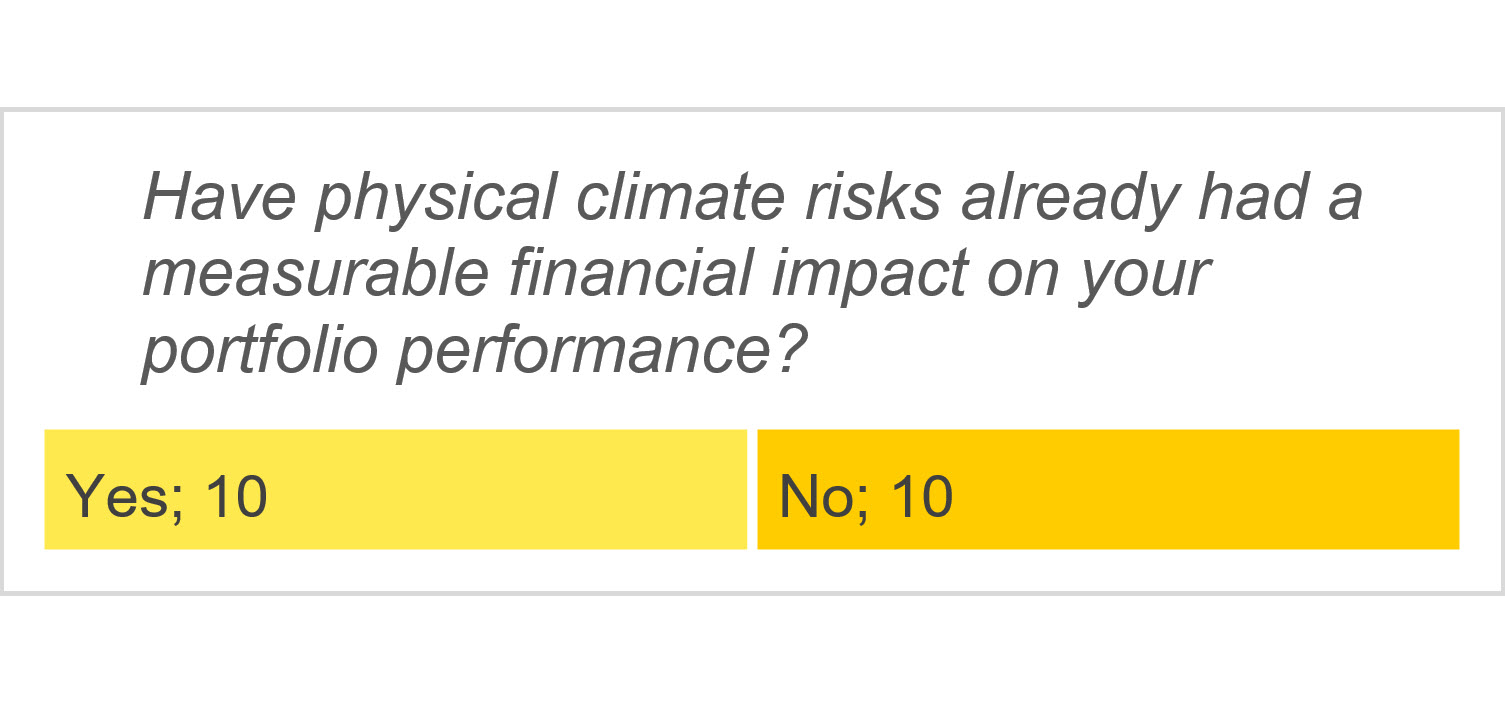
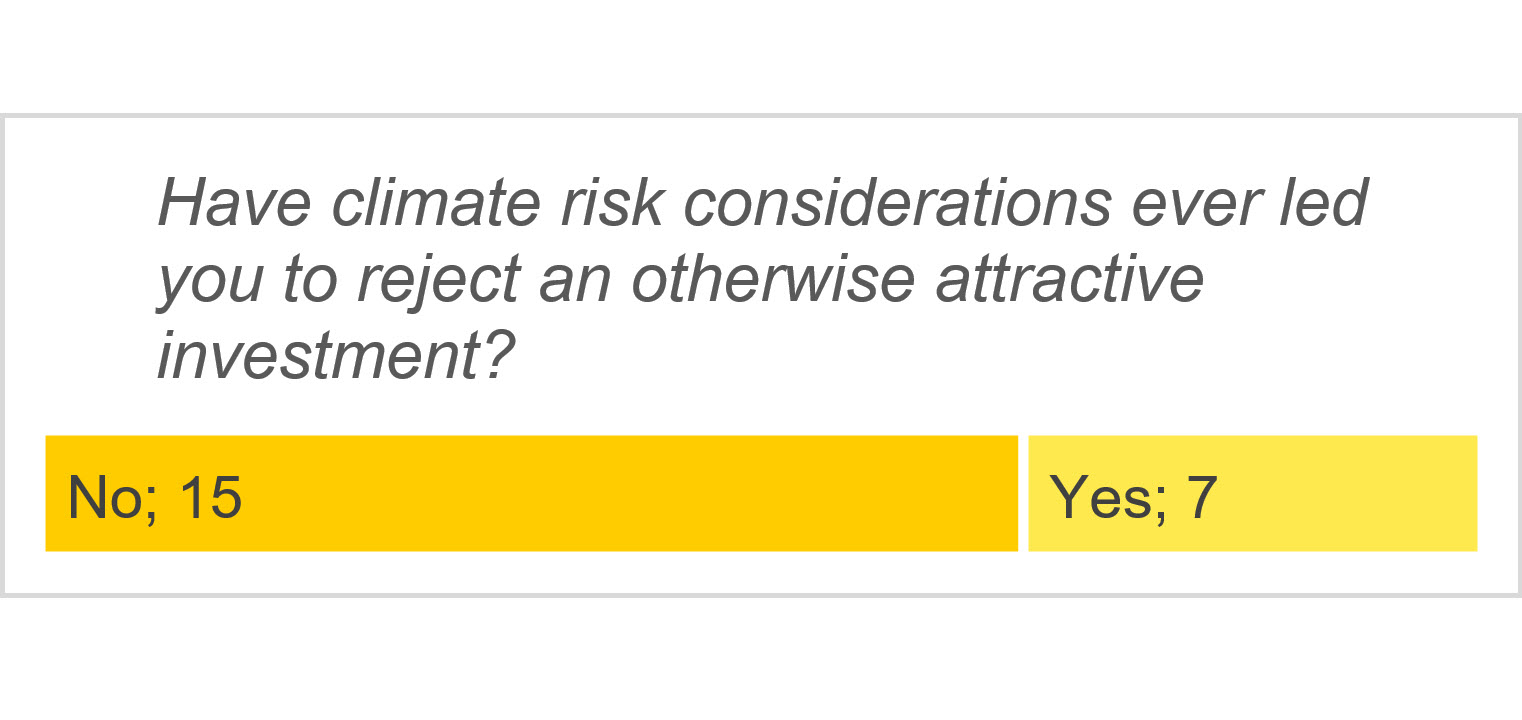
A live survey among participants indicated an “awareness – action gap”: while climate risks are widely recognised, their consistent integration into investment processes continues to evolve. See results from two non-representative questions asked as part of the survey below¹:
Selected Takeaways
Climate targets and measurement challenges
Leonhard Forster (Munich Re Global Investment Management) highlighted Munich Re’s progress against 2025 climate investment targets and outlined our forward-looking ambitions. He also emphasised an important distinction: portfolio decarbonisation is not the same as real-world decarbonisation —a distinction currently being discussed by investors and regulators alike.
Physical climate risks in financial terms
Thomas Krismer (Munich Re Climate Advisory) illustrated how physical risks are already materialising financially, with weather-related losses having tripled since the 1990s. An illustrative case study on photovoltaic assets and hail damage risks underlined these statements. Related to corporate risk perception, Thomas refers to an optimism bias detected through the 2023/2024 Munich Re Climate Preparedness Survey: 75% of companies which have experienced high to very high NatCat and climate risks in the past also expect a future impact. In contrast, only 13% of companies which experienced no impact in the past expect a future impact.
As visible in the graph below, about a third of our audience correctly estimated the size of uninsured losses from natural catastrophes.
What share of global financial losses from natural catastrophes is currently uninsured?
Assessing credible transition strategies
Jonas Jebabli (Munich Re Investment Partners) addressed the challenge of identifying companies with robust transition pathways. This requires going beyond disclosures to assess tangible progress, capital allocation, and business model alignment. Investment Partners’ Climate Transition Corporate (CTC) Score was presented as one framework developed to support such analysis.
In assessing the extent to which climate risks are priced into capital markets, participants provided responses on a five-point Likert scale (1 = not priced in at all; 5 = fully priced in), yielding a mean score of 2.1 (below you can also see the distribution of the votes). Our audience thus estimated a clear underpricing of climate risks in capital markets. Investors may be cautious and hesitant to adjust their portfolios given the uncertainty as to when climate risks will be fully priced.

This survey had 26 participants
Enabling investments through risk transfer
Matthias Tönnis (Munich Re Green Tech Solutions) demonstrated how Munich Re’s Exploration Risk Insurance can support the investment case by mitigating specific risks of greenfield geothermal projects into investable opportunities by de-risking the exploration phase. This highlights the critical role of insurance in enabling capital to flow into climate solutions, leveraged through a public-private partnership with KfW, a German development bank.
Developments in Insurance-Linked-Securities (ILS)
Fabian Frank (Munich Re Capital Partners) outlined the latest ILS trends with focus on NatCat bonds. The market now exceeds US$60bn. Yields of ~16% were earned, especially in early 2023, receding to ~9% by May 2026, reflecting recent market conditions. More recently, ILS are expanding into newly ceded underwriting risk allowing for broader investor participation reflecting the market’s maturation.
In terms of perceived importance of portfolio risks over the next 3 – 5 years, our audience ranked climate-related risks last from a list of five risk factors. This may imply that although climate-related risks are acknowledged, they are still mainly considered a longer-term or secondary concern.
How do you currently rank these risks for your portfolio over the next 3-5 years?
Climate risk is financial risk – a perspective worth further consideration
If you are interested in a deeper dive into any of the topics or would like to receive detailed presentation materials, please feel free to contact us via contact@munichreinvestmentpartners.com. We would be happy to continue the conversation.
Disclaimer
The information contained herein reflects views and opinions expressed at the time of the conference and may be subject to change without notice. No representation or warranty is made as to its accuracy or completeness. It is for informational purposes only and does not constitute a recommendation or advertisement for specific financial instruments. Sustainable financial products are also offered by Munich Re Investment Partners. This document does not relate to, or promote, any specific financial product or investment strategy.
- Target Audience
This document is intended exclusively for professional clients as defined by Directive 2014/65/EU (MiFID II). - Nature of this Document
The content and scope of this document constitute marketing communication in accordance with Article 36 (2) of Delegated Regulation (EU) 2017/565 under MiFID II. It does not constitute investment research as defined in Article 36 (1) of the same regulation. This document has not been prepared in accordance with legal requirements designed to promote the independence of investment research and is not subject to any prohibition on dealing ahead of the dissemination of investment research. - No Offer, no Advice
The information provided is not to be construed as personal investment advice or recommendation, or offer to buy or sell or solicitation or recommendation of any offer to subscribe, to buy or sell or to participate in any financial product or to engage in any investment strategy. Since not all products or strategies are suitable or appropriate for all investors, before entering any transaction it is recommended to consult independent advisors (including but not limited to legal and tax advisor) to make sure, irrespective of the information herein, the planned investment fits the needs and preferences of the investor and all involved risks are fully understood.
Any sustainability-related, climate-related or transition-related statements in this document reflect the views and information presented at the conference. They should not be understood as claims of measurable real-world climate impact, guaranteed emissions reductions, or verified alignment with any specific climate objective.
Survey results shown in this document are non-representative live audience responses from conference participants only and should not be interpreted as evidence of broader investor or market sentiment. - Disclaimer of Liability
In preparing this document, we have relied upon and assumed, without independent verification, the accuracy and completeness of all information available from sources deemed reliable or which was otherwise reviewed by us. No representation or warranty, expressed or implied, is made as to the accuracy or completeness of the information contained in this document, and nothing contained herein is, or shall be relied upon as, a promise or representation. No liability shall be assumed for any losses or damages whatever its nature is (including but not limited to any direct, indirect or consequential loss or loss of profit) and which may result from or be in connection with this document or the reliance upon the information provided. - Regulatory Status of the Investment Firm
Munich Re Investment Partners GmbH is authorised as an investment firm by the German Federal Financial Supervisory Authority (Bundesanstalt für Finanzdienstleistungsaufsicht – BaFin) and jointly supervised by the BaFin and the German Central Bank (Deutsche Bundesbank).